← Back to projects
Social Cognition Case Study
Testing how depth changes face perception
A published 2D vs 3D face-similarity project using Unity-based stimuli, large-scale online behavioral data, and representational alignment.
Technical Layer
Tools & Methods
- Unity
- UXF
- 3D stimuli
- RSA
- Behavioral data
My role
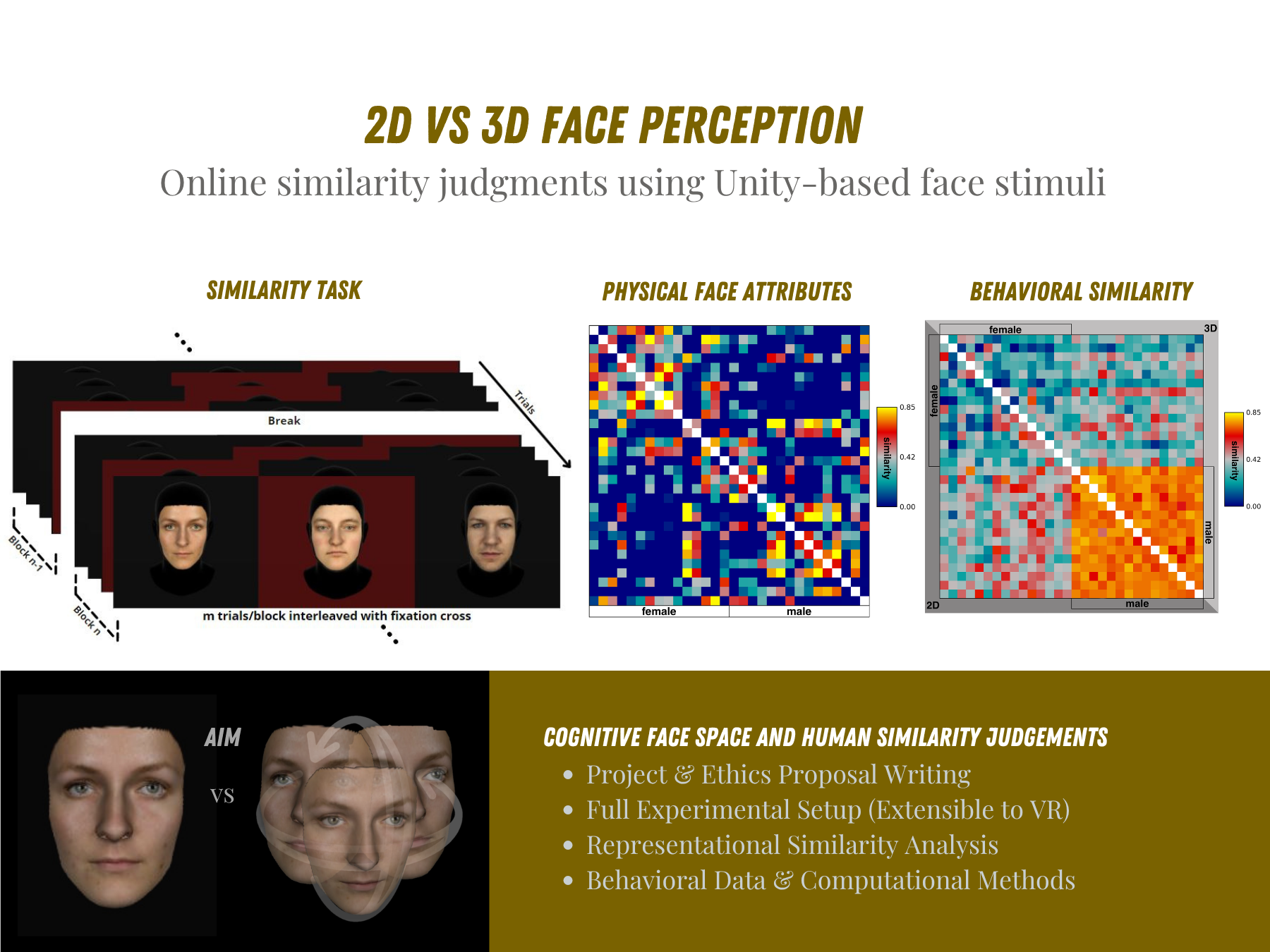
With the Mind-Body-Emotion Group at the Max Planck Dahlem Campus of Cognition, I helped write the project and ethics proposal, designed stimuli for an online 3D vs 2D experiment using Unity eXperimental Framework, worked with representational similarity analysis on behavioral data and contributed to publishing the outcome.
The problem
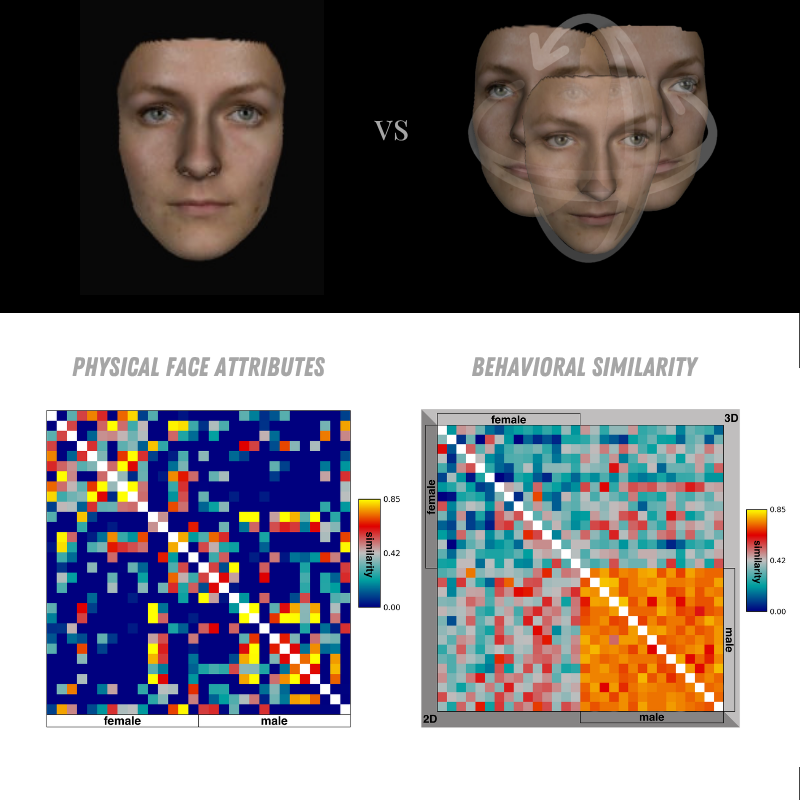
Face perception is usually studied with flat images, but real faces are three-dimensional, dynamic, and viewed from changing perspectives. The project asked whether similarity judgments remain stable when faces are presented in 2D versus 3D.
The experimental idea
Participants judged face similarity in an online task. By comparing judgments across 2D and 3D presentation conditions, the project tested whether depth changes the structure of perceived face space.
The technical contribution
I contributed to the project and ethics proposal process and designed stimuli for the online 2D vs 3D experiment using Unity eXperimental Framework, a setup that could be extended toward VR-based experiments.
The analysis frame
Representational similarity analysis was used to compare behavioral similarity matrices and examine how perceived face relations differed across viewing conditions.
Why this matters
For social cognition and human-centered technology, this project connects stimulus design, behavioral data, and computational modelling. It shows how perception can be studied as a structured representational space rather than as isolated responses.
Primary outputs
Primary outputs
Featured in
Coverage
Continue Exploring
Explore the wider body of work.
Further projects span physiological computing, computational neuroscience, embodied systems, and interdisciplinary engineering.