← Back to projects
Wearable AI Case Study
Real-time sleep staging from wearable EEG
A smartphone-based system for classifying sleep stages from single-channel EEG using deep learning and power spectral analysis.
Technical Layer
Tools & Methods
- Wearable EEG
- TensorFlow Lite
- Deep learning
- Sleep-EDF
- Muse
- Power spectral analysis
- BioEssence integration
My role
At the MIT Media Lab, I developed an end-to-end sleep-staging smartphone application using a deep-learning model trained on Sleep-EDF and adapted for wearable EEG. I built EEG and IMU data pipelines, implemented raw EEG visualization, and programmed EEG power spectral analysis across alpha, beta, gamma, delta, and theta bands. I also developed a connector module linking the sleep application with BioEssence, a wearable olfactory display designed to monitor cardio-respiratory information and support physiology-aware scent interventions for mental wellbeing.
The problem
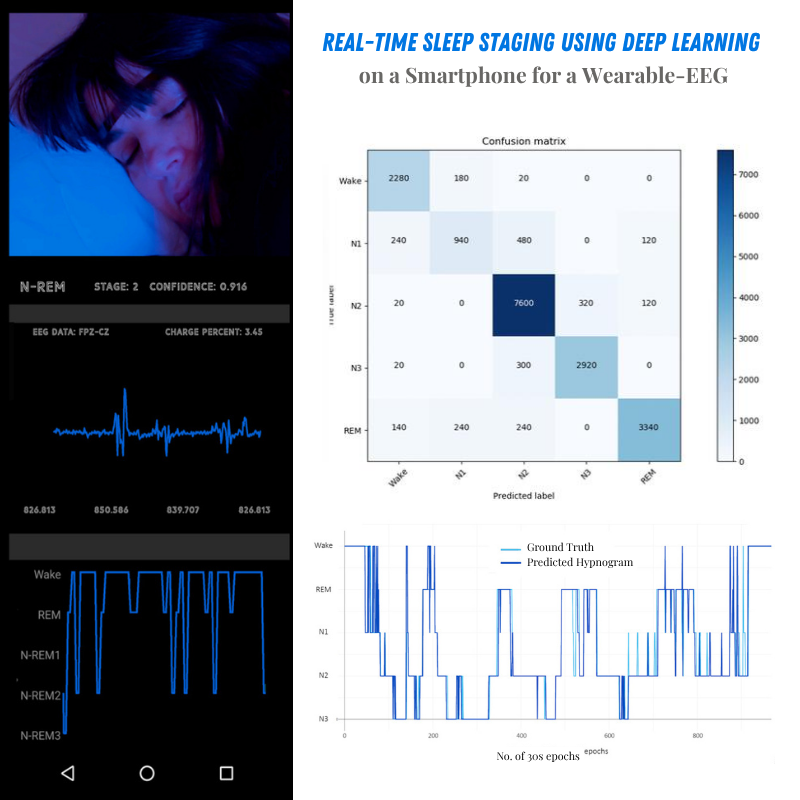
Polysomnography is the gold standard for sleep staging, but it is resource-intensive, wired, and usually dependent on expert scoring in a sleep-lab setting. The project asked whether a lightweight wearable EEG and smartphone pipeline could classify sleep stages in real time.
The system
The system used a modified Muse EEG headband, Bluetooth data streaming, smartphone-based inference, and a TensorFlow Lite application to classify sleep stages from single-channel EEG.
The modelling approach
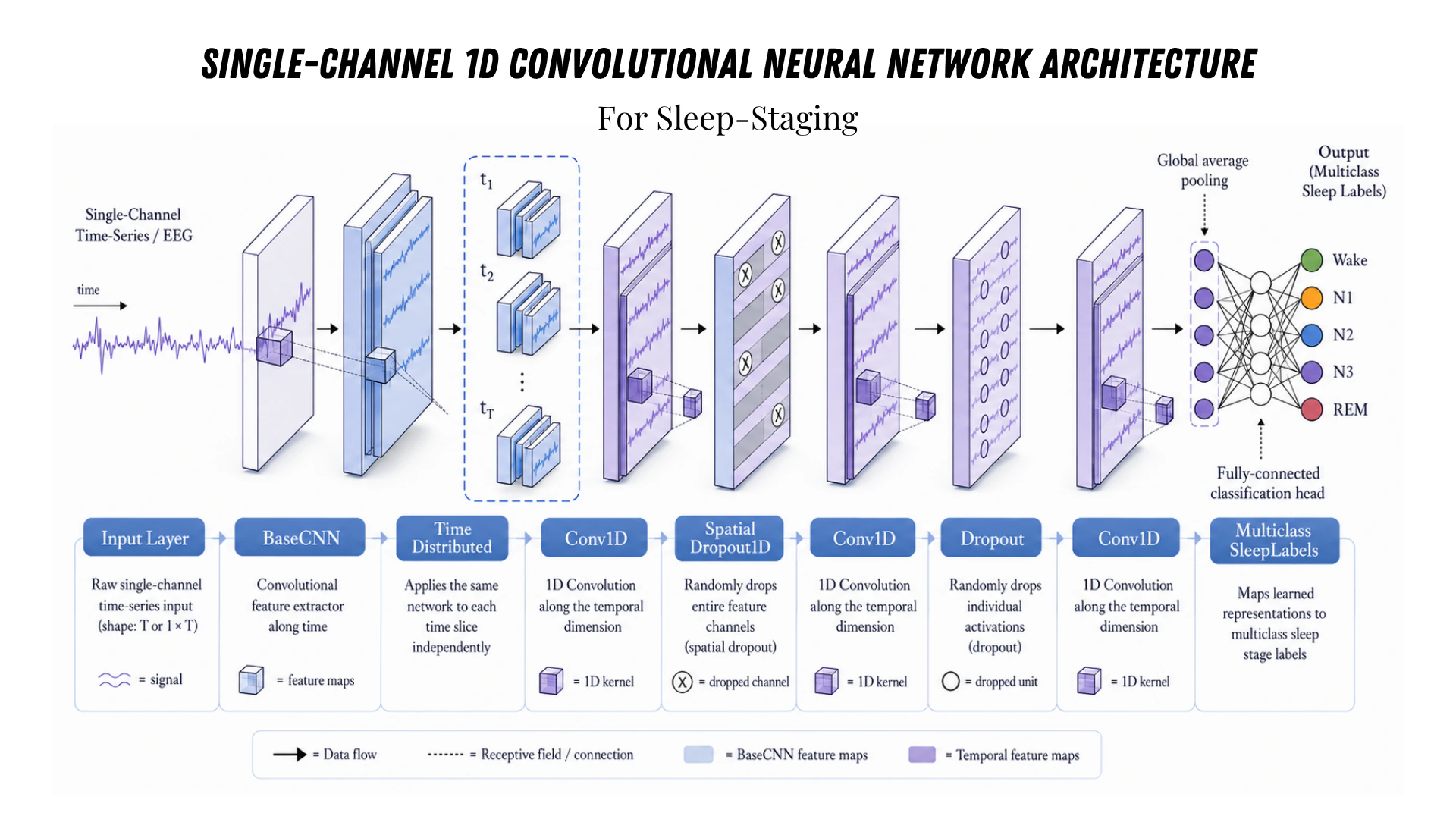
The deep-learning pipeline adapted a time-distributed convolutional neural network for five-stage sleep classification using the open Sleep-EDF dataset, with inference designed to run directly on a smartphone.
The signal-analysis layer
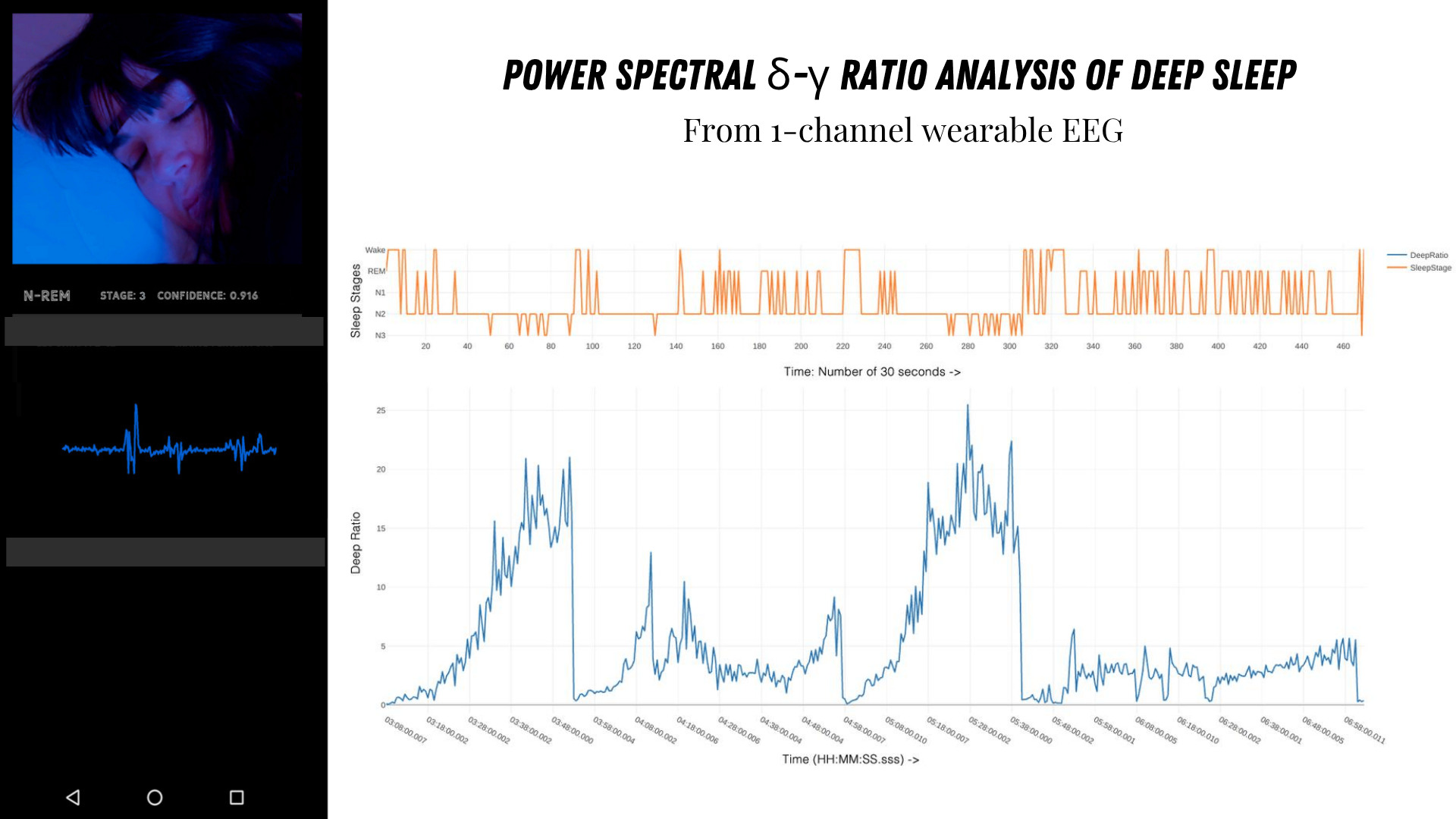
Alongside the model, I programmed power spectral analysis to inspect EEG power bands including alpha, beta, gamma, delta, and theta across sleep stages. This helped provide an interpretable signal layer beyond the neural-network output.
Why this matters
For digital health and neurotechnology, this project connects wearable biosensing, on-device machine learning, real-time physiological inference, and intervention-ready sleep interfaces.
Primary outputs
Primary outputs
Featured in
Coverage
Continue Exploring
Explore the wider body of work.
Further projects span physiological computing, computational neuroscience, embodied systems, and interdisciplinary engineering.